
When most people think about body fat, they think about the stuff they can see and grab around their stomach, arms, or thighs.
But some of the most important fat in your body is completely hidden.
It's called visceral fat.
Unlike the fat directly underneath your skin, visceral fat accumulates deep inside your abdomen around organs like your liver, intestines, and pancreas.
We all have some visceral fat, and that's normal. The problem is when we accumulate too much of it.
So let's talk about what visceral fat actually is, how it gets there, why we care about it, and most importantly…
How we get rid of it.
Different Types of Fat
The two types I want you to understand are subcutaneous fat and visceral fat.
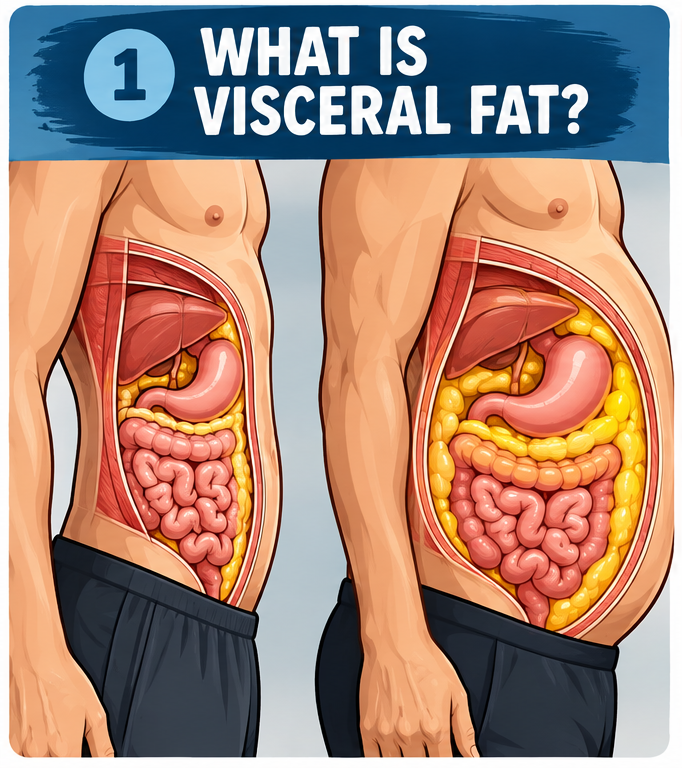
Subcutaneous fat is located directly underneath your skin.
Grab the fat around your stomach. That's mostly subcutaneous fat.
Visceral fat is deeper.
It sits underneath the abdominal muscles and accumulates around your internal organs.
Interestingly, visceral fat generally makes up a relatively small percentage of our total body fat. Most of our body fat is subcutaneous.
But where fat is stored matters.
Visceral fat is much more metabolically active than the fat sitting underneath your skin, which is why carrying too much of it is associated with more health problems.
How Does Fat End Up Around Our Organs?
Think of body fat as energy storage.
When you regularly consume more energy than your body uses, that extra energy has to go somewhere. One of the body's solutions is to package that energy into triglycerides and store it inside fat cells.
Some gets stored underneath your skin.
Some gets stored inside the abdominal cavity as visceral fat.
Where your body prefers to store fat is influenced by several things, including:
Genetics
Sex
Age
Hormones
Overall body-fat level
Physical activity
Diet
Sleep
Stress
This is why two people of the same height and weight can have very different body-fat distributions.
You can also develop ectopic fat, which is slightly different. This is fat accumulating in tissues that aren't primarily designed to store large amounts of it, such as the liver, pancreas, muscles, and heart.
Fatty liver disease is probably the best-known example.
So when someone develops a large amount of abdominal fat, we aren't just concerned with how their stomach looks. We're interested in where that fat is being stored internally.
Why Is Visceral Fat Bad?
Fat isn't just dead weight sitting around your organs.
Fat tissue is biologically active.
It communicates with the rest of your body by releasing hormones, fatty acids, and signaling molecules.
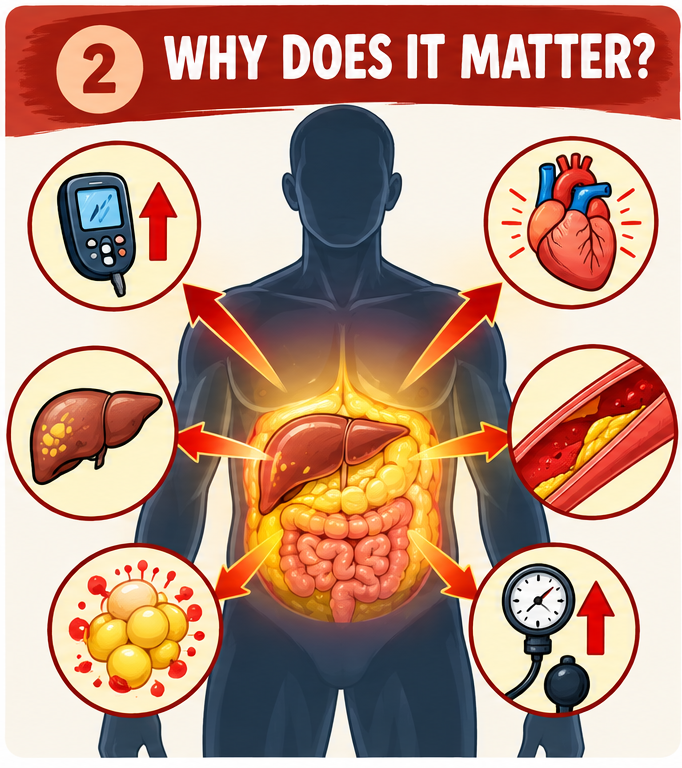
Excess visceral fat tends to produce a more inflammatory and metabolically unhealthy environment.
Over time, higher amounts of visceral fat are associated with:
Insulin resistance
Type 2 diabetes
High blood pressure
Abnormal cholesterol and triglycerides
Fatty liver disease
Cardiovascular disease
This is why someone can have a relatively normal body weight and still have metabolic problems if they're carrying a disproportionate amount of their fat around their abdomen.
It also explains why body weight alone doesn't tell us everything about health.
Where you carry the weight matters.
How Do You Know If You Have Too Much?
You can't accurately determine visceral fat just by looking in the mirror.
CT and MRI imaging can directly measure it, but obviously we're not going to put everyone through an MRI just to check their belly fat.
A much easier screening tool is your waist circumference.
A growing waistline can be a useful warning that abdominal and visceral fat are increasing.
Body-fat measurements can also be useful, although different methods have different levels of accuracy.
The important thing is to watch the trend.
If your weight hasn't changed much over five years but your waist has increased several inches, your body composition may have changed considerably.
So How Do We Get Rid of Visceral Fat?
Here's the good news:
Visceral fat responds quite well to lifestyle changes.
And you cannot spot-reduce it.
Doing 500 crunches isn't going to specifically burn the fat around your liver.
Your body decides where it pulls stored energy from.
Instead, we need to improve overall energy balance and metabolic health.
#1 Exercise
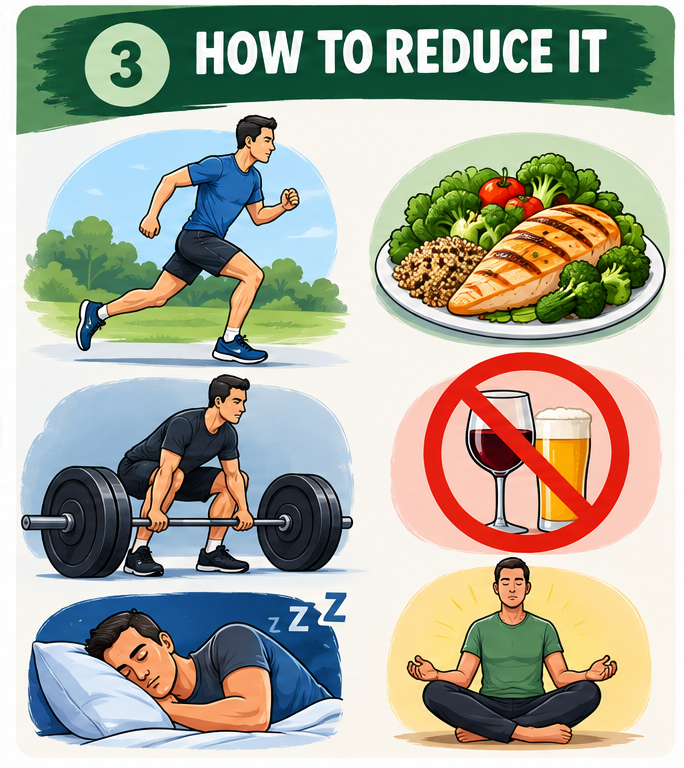
Exercise is probably one of our best tools for fighting visceral fat. Both Cardio and Strength are needed.
Cardiovascular exercise is particularly effective.
That could include:
Brisk walking
Hiking
Cycling
Swimming
Running
Interval training
Higher-intensity cardio exercise can be especially effective if you're healthy enough to tolerate it.
But don't ignore strength training.
I still want you lifting weights.
Strength training helps preserve or build muscle while you're losing fat, improves insulin sensitivity, and makes maintaining a healthy body composition much easier long term.
Ideally, I like a combination of cardiovascular exercise and strength training rather than choosing one or the other.
#2 Lose Excess Body Fat
If you're carrying excess body fat, losing some of it will generally reduce visceral fat as well.
This requires consistently using more energy than you're consuming.
It doesn't require a crazy diet.
You can accomplish it by:
Eating more protein
Eating more fruits and vegetables
Increasing fiber
Reducing highly processed, calorie-dense foods
Cutting back on liquid calories
Controlling portion sizes
Increasing daily activity
You don't need to starve yourself.
You need a nutrition strategy you can maintain long enough for it to actually work.
#3 Pay Attention to Alcohol
Alcohol can make controlling calories and body composition considerably harder.
Alcohol itself contains calories, and alcoholic drinks often contain additional calories from sugar.
If someone is trying to reduce abdominal fat but regularly drinks several nights per week, alcohol is one of the first places I would look for calories that could potentially be reduced.
#4 Sleep Matters
Don't ignore sleep.
Poor sleep can make appetite regulation, food choices, recovery, and exercise more difficult.
If you're sleeping five hours per night, exhausted all day, eating convenience food, and relying on caffeine to function, simply telling yourself to "eat less" probably isn't a great long-term strategy.
Fix the environment that is making healthy behavior difficult.
Don't Judge Your Progress Only by the Scale
This is probably my favorite part of this topic.
You can become metabolically healthier without seeing a dramatic change on your bathroom scale.
Exercise studies have found reductions in visceral fat even when total body weight doesn't change very much.
Imagine someone starts exercising regularly.
They lose some visceral fat.
They lose some subcutaneous fat.
They gain some muscle.
Their body weight might barely change.
But internally, they're considerably healthier.
That's why I prefer looking at several measurements:
Body weight + waist circumference + body composition + strength + cardiovascular fitness
Those tell us much more than body weight alone.
The Big Picture
I don't want people obsessing over having a perfectly flat stomach.
Having body fat is normal.
Having some visceral fat is normal.
The goal isn't zero fat.
The goal is preventing excessive visceral fat accumulation while maintaining plenty of healthy muscle.
And fortunately, the prescription isn't particularly exotic:
Lift weights.
Do cardiovascular exercise.
Eat mostly nutritious foods.
Maintain a healthy body-fat level.
Sleep enough.
Don't regularly consume more calories than your body needs.
Nothing fancy.
But consistently doing those things for years is one of the best investments you can make in your long-term health.
Thanks for reading. Stay strong!
-Brandon